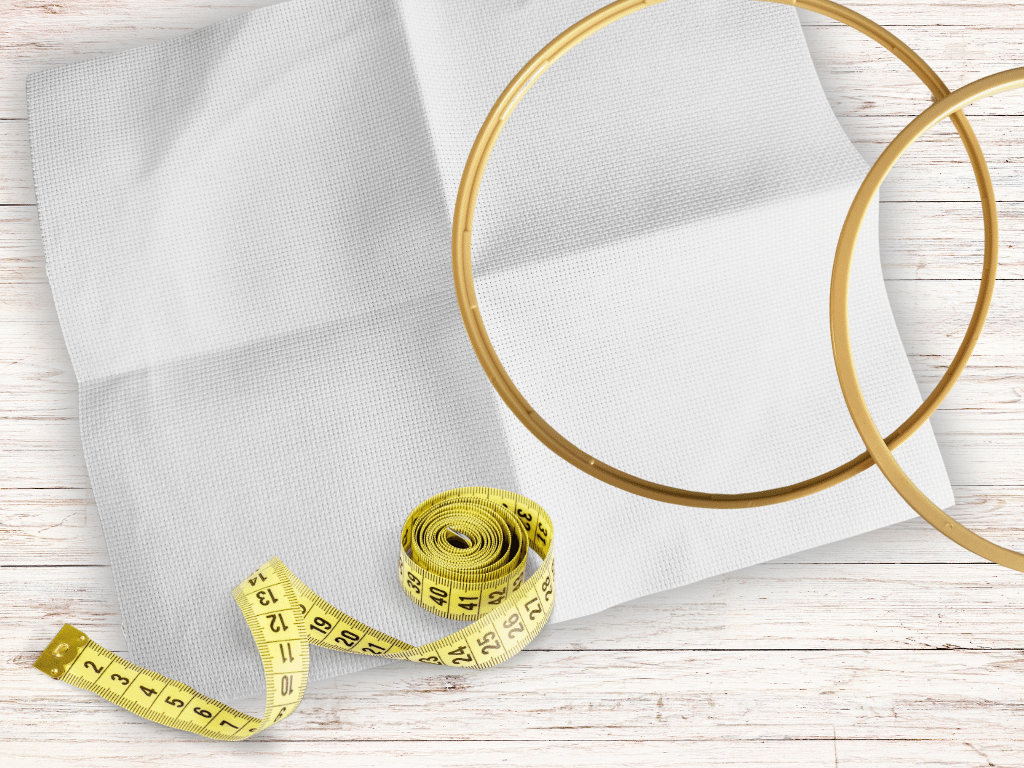
Every cross stitch pattern has a stitch count (width x height in stitches). To work out how much fabric you need, divide the stitch count by the fabric count and add margins.
If you want a quick answer, use our cross stitch fabric calculator to get the exact dimensions for any pattern and fabric count.
The Formula
Finished size = stitch count ÷ fabric count
For example, a pattern that is 100 stitches wide on 14-count Aida:
100 ÷ 14 = 7.1 inches wide
That gives you the stitched area. You then need to add extra fabric for margins.
Step-by-Step Calculation
- Find the stitch count from your pattern. It will show the width and height in stitches (e.g., 100 x 150).
- Choose your fabric count. Common options: 14-count (beginner), 16-count, 18-count (detailed), or 28-count evenweave.
- Divide the stitch count by the fabric count for each dimension.
- Add margins. Add at least 3 inches per side (6 inches total) for hoop clearance and framing.
Worked Example
Pattern: 100 stitches wide x 150 stitches tall, on 14-count Aida.
- Width: 100 ÷ 14 = 7.1 inches
- Height: 150 ÷ 14 = 10.7 inches
- With margins: 13.1 inches x 16.7 inches
You would need a piece of fabric at least 13 x 17 inches.
Our fabric size calculator does this maths for you and shows results in both inches and centimetres.
How Fabric Count Changes the Finished Size
The same pattern produces very different finished sizes depending on the fabric count:
| Stitch Count | 14-count | 16-count | 18-count | 22-count |
|---|---|---|---|---|
| 50 x 50 | 3.6 x 3.6 in | 3.1 x 3.1 in | 2.8 x 2.8 in | 2.3 x 2.3 in |
| 100 x 100 | 7.1 x 7.1 in | 6.3 x 6.3 in | 5.6 x 5.6 in | 4.5 x 4.5 in |
| 150 x 150 | 10.7 x 10.7 in | 9.4 x 9.4 in | 8.3 x 8.3 in | 6.8 x 6.8 in |
| 200 x 200 | 14.3 x 14.3 in | 12.5 x 12.5 in | 11.1 x 11.1 in | 9.1 x 9.1 in |
Higher fabric counts produce smaller, more detailed stitches. Lower counts produce larger stitches and bigger pieces.
Choosing a Hoop Size

Your hoop should be slightly larger than the stitched area (not the total fabric size). Using the 100 x 150 stitch example on 14-count:
- Stitched area: 7.1 x 10.7 inches
- A 10-inch or 12-inch hoop would work well
For a quick reference:
| Stitched Area | Suggested Hoop |
|---|---|
| Up to 4 inches | 6-inch hoop |
| 4-7 inches | 8-inch hoop |
| 7-10 inches | 10-inch hoop |
| 10+ inches | 12-14 inch hoop or scroll frame |
Choosing the Right Fabric Count

Not sure which fabric count to use? Here are the common options:
- 14-count Aida – The most popular choice. Good stitch visibility, suitable for most patterns. Use 2 strands of floss.
- 16-count Aida – Slightly finer. Good for patterns with moderate detail.
- 18-count Aida – Produces smaller stitches with more detail. Good for portraits and intricate designs. Use 1-2 strands.
- 28-count evenweave – Stitched over 2 threads, equivalent to 14-count. Gives a smoother finish than Aida.
If you are creating a pattern with our pattern maker, you can set the stitch width before generating. The calculator on the result page shows the finished size for different fabric counts.
Tips
- Always buy more fabric than you think you need. Adding 3 inches per side is the minimum. If you plan to frame the piece, add 4-5 inches.
- Check the pattern dimensions first. Some patterns list stitch count, others list finished size at a specific fabric count. Make sure you know which you are looking at.
- Use our fabric calculator to avoid manual maths. Enter your stitch count and fabric count and it calculates everything, including margins.
FAQ
How do I calculate cross stitch fabric size? Divide the stitch count by the fabric count to get the stitched area in inches, then add 6 inches (3 per side) for margins. For example: 140 stitches on 14-count = 10 inches + 6 inches margin = 16 inches.
What size Aida do I need for a 100-stitch pattern? On 14-count Aida, 100 stitches = 7.1 inches. With margins, you need approximately 13 inches of fabric.
How much extra fabric should I add for framing? Add at least 3 inches per side (6 inches total per dimension). For professional framing, 4-5 inches per side gives more flexibility.
Does fabric count affect the size of my finished piece? Yes. The same pattern will be larger on 14-count fabric and smaller on 18-count fabric. Use our cross stitch calculator to compare sizes across different fabric counts.