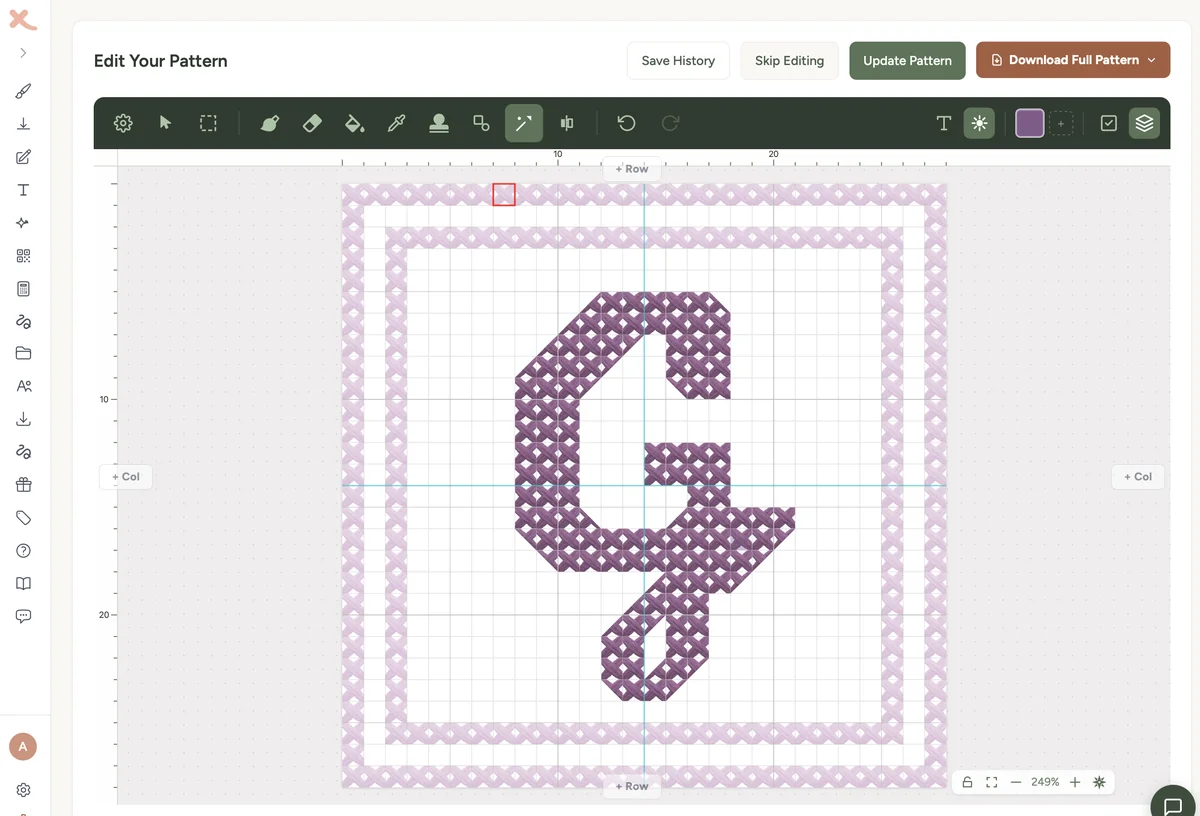
A cross stitch monogram is one of the simplest ways to make a stitched piece feel personal. One initial on a hoop, two initials on a wedding gift, or a neat set of initials in the corner of a towel can turn a plain pattern into something that belongs to a specific person.
This guide shows how to design cross stitch monogram patterns with the tools Xstitchify has today. It focuses on single initials and initial pairs, because those are quick to make in the cross stitch text generator and easy to finish with a border. Traditional three-letter monograms are possible too, but they need a more manual workaround, so they are covered honestly as an advanced option rather than a one-click promise.
On this page
- What is a cross stitch monogram?
- Single initial, initial pair or three-letter monogram?
- Monogram letter order and etiquette
- A short history of stitched initials
- Choose the right monogram font
- How to make a monogram with the text generator
- A worked wedding monogram example
- Sizing monograms for common projects
- Backstitch vs filled cross stitch monograms
- Colour choices for initials
- Borders, frames and wreath-style layouts
- Project ideas for monogram cross stitch
- Using your own font for branded monograms
- Common monogram mistakes
- FAQ
- Final thoughts
What is a cross stitch monogram?
A cross stitch monogram is a stitched initial or group of initials used as the main design, a decorative accent, or a maker’s mark. It can be as simple as one large letter in the centre of a hoop, or as formal as three initials arranged in a traditional family monogram.
In counted cross stitch, the letter is treated like any other charted shape. The pattern sits on a grid, each filled square becomes a cross stitch, and any line-based details become backstitch. That makes monograms very forgiving for digital design: you can test the letter height, spacing and border before you cut fabric or thread a needle.
A monogram is different from a name chart because it relies on proportion and negative space. A full name needs legibility across several letters. A monogram needs one or two letters to look balanced, intentional and gift-worthy. The best cross stitch monogram patterns are usually not complicated. They are clear, centred and sized for the object they will live on.
Use monograms when you want a project that feels personal but not wordy: wedding initials, a baby’s first initial, a housewarming gift, a towel corner, a lavender sachet, a hoop ornament or a stitched signature in the corner of a larger sampler.
Single initial, initial pair or three-letter monogram?
Before choosing a font, decide what kind of monogram you are making. The layout matters more than the alphabet.
Single-initial monograms are the easiest and cleanest option. Choose one letter, make it large enough to hold the centre of the design, then add a simple circle, heart, flower or diamond border in the pattern editor. This works well for baby blankets, stocking tags, bookmarks, ornaments and small hoops.
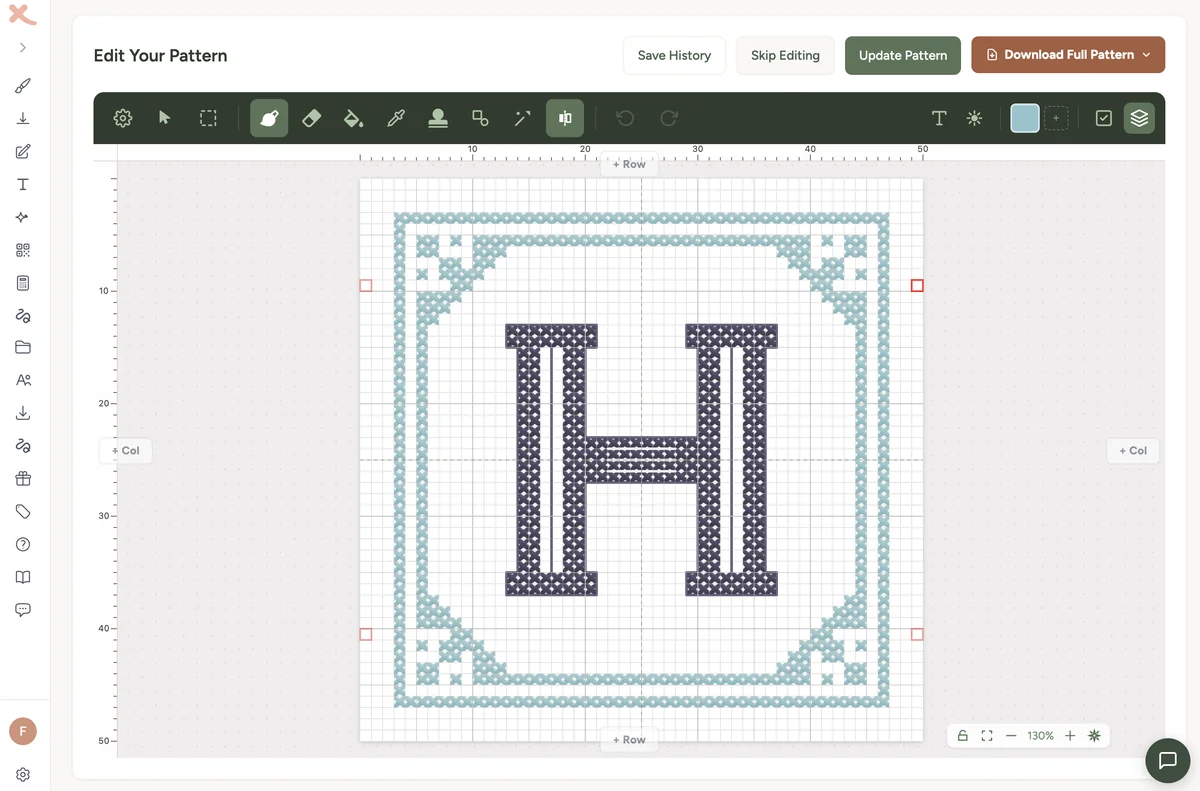 A single-initial H monogram with a symmetric square border, designed in the Xstitchify pattern editor. The border corners were drawn once and mirrored to the other three corners using the editor’s symmetry mode, which keeps the frame perfectly balanced without manually counting each corner.
Initial pairs are the best fit for couples and shared gifts. Two letters at the same height read as modern and balanced, especially when stitched in Script, Serif, Italic or a backstitch alphabet. For example, opening the text generator with AB gives you a quick starting point for wedding ring pillows, anniversary hoops or napkin corners.
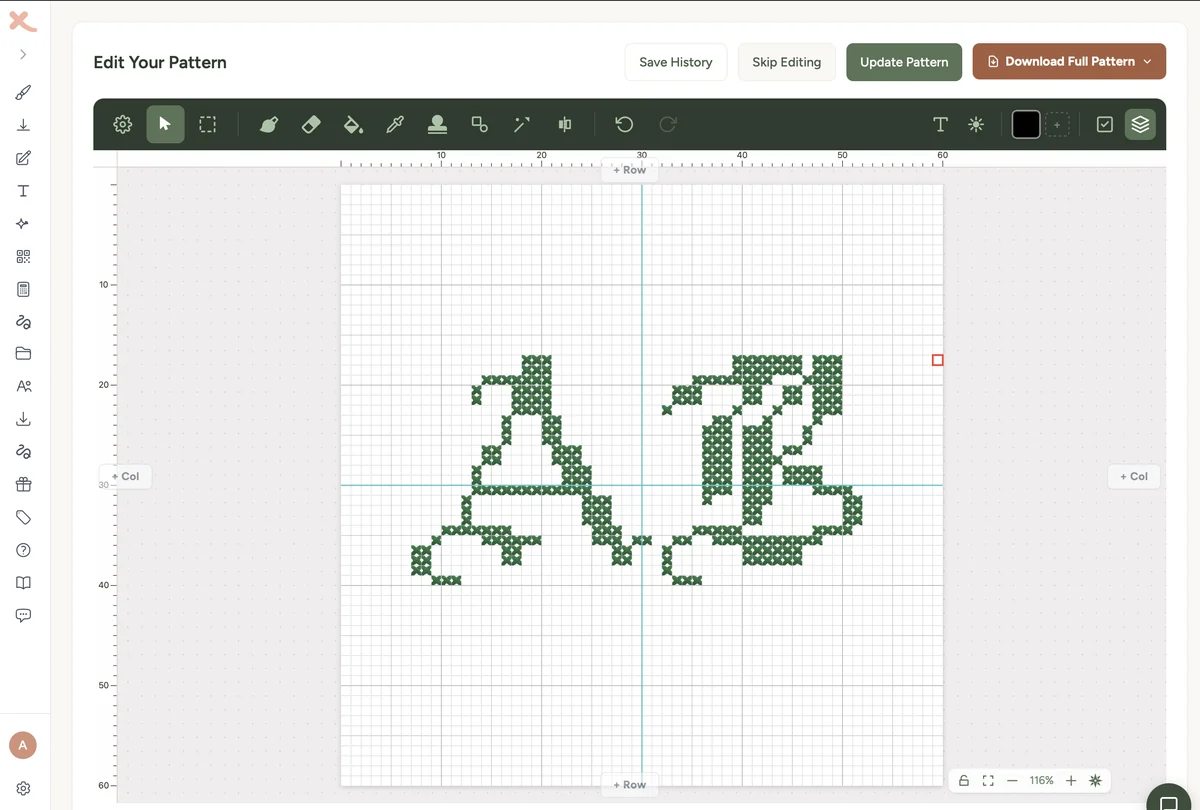 An AB initial pair in a flourished calligraphy font, generated in the cross stitch text generator and opened in the editor for a final size and spacing check. Two same-height letters read as balanced and intentional - a flat-style modern pairing suitable for wedding or anniversary pieces.
Traditional three-letter monograms usually place the surname initial large in the centre, with the first and middle initials smaller on either side. Xstitchify does not currently have a one-click monogram mode for that layout. The honest workaround is to generate the three initials separately, bring them into the editor, and arrange the centre initial larger by hand. That works if you are comfortable editing a chart, but it is not the fastest beginner route.
If you are making your first monogram, start with a single initial or an initial pair. You will get a cleaner result faster, and you can still make the piece feel traditional with the right font, fabric and border.
Monogram letter order and etiquette
Monogram order trips up more people than the stitching does. The rules are short, but they vary by layout, occasion and tradition. Here is what most British and American etiquette guides agree on.
Traditional three-letter monogram order
In a traditional three-letter monogram, the surname initial goes in the centre and is the largest. The first-name initial sits on the left, smaller. The middle-name initial sits on the right, smaller. Read aloud as a name, this looks counterintuitive - you do not stitch initials in the order they are spoken.
Example: Jane Marie Smith becomes J S M, with the S central and noticeably bigger than the J and M. The same person’s spoken initials are JMS, but the monogram reads J-S-M.
This convention dates to a time when household linens were marked with a family identifier, so the surname mattered most. Stitchers wanted the family letter to dominate.
Married couples
For a traditional married-couple monogram, the same large-surname rule applies, with the couple’s first-name initials flanking it. Conventions vary:
- Bride’s first initial on the left is the most common British and American etiquette: bride’s first | shared surname (large) | groom’s first. So Jane Smith and John Smith stitches as J S J.
- Groom’s first initial on the left is the older convention sometimes preferred for joint household items used by both partners.
- Together, in order spoken: many modern couples skip the centre-large rule entirely and stitch initials at equal size, with the surname between or below the first-name initials.
If the monogram is for a wedding gift and you are unsure, ask the couple. The polite default if you cannot ask is bride’s first initial on the left.
Same-sex couples and non-traditional pairings
There is no single “correct” order for same-sex couples - the traditional rules assumed an opposite-sex couple with a shared surname. Modern conventions:
- Order initials alphabetically by first name if both partners have changed to a shared surname
- Use both surnames as a paired monogram if they kept different surnames - for example A S | M J for Alex Smith and Morgan Jones
- Skip the large-centre layout in favour of a flat-style monogram if the traditional layout feels unnecessary
The honest answer is that the person receiving the gift gets to choose, and asking is more important than guessing.
Family monograms
A family monogram uses the surname initial alone, often inside a wreath or border, often paired with the year the family was formed (marriage year) or a moved-in date for a housewarming piece. This works well for front-door hoops, kitchen towels for the family kitchen and shared household linens.
Single-name and unmarried-adult monograms
For an unmarried adult monogram, the same large-surname rule applies: first | LAST (large) | middle. For an adult who uses only two names or prefers initials in spoken order, a flat-size two-letter monogram is perfectly correct. Modern monograms often skip the centre-large convention entirely - that is a stylistic choice rather than an etiquette breach.
Item-specific traditions
| Item | Traditional convention |
|---|---|
| Wedding linens (towels, sheets, table) | Bride’s first |
| Bridal trousseau before the wedding | Bride’s maiden name initials |
| Personal stationery, handkerchiefs | First |
| Modern stationery | All same size, often first-last-middle in spoken order |
| Baby items | Baby’s initials only, large-centre style optional |
| Family heirlooms and christening gowns | Often year + surname initial only |
| Maker’s marks on samplers | Stitcher’s initials + year, usually in a small backstitch script |
When to break the rules
Etiquette is a starting point, not a law. The rules exist because shared linens used to need clear ownership marks; modern monograms are usually decorative. If the recipient prefers initials in spoken order, or only wants their first-name initial, do that. The best monogram is the one the person likes looking at.
A short etiquette check before stitching saves a lot of unpicking. If the gift is significant - a wedding, a christening, a major anniversary - confirm the layout before threading a needle.
A short history of stitched initials
Initials have been stitched into household textiles for practical and decorative reasons for centuries. Linen, towels, clothing and school samplers often carried letters so items could be identified, sorted, taught or proudly displayed. In older samplers, alphabets were also proof that the stitcher could count, space letters and work neatly across a fabric grid.
The broader idea of a monogram is a motif made by combining letters into one symbol, often initials for a person, family, organisation or maker. Embroidery gives that idea a tactile form: a marked linen corner, a sampler alphabet, or a pair of wedding initials can all sit between usefulness and sentiment.
If you like the sampler side of the tradition, our guide to backstitch alphabet patterns shows how Victorian samplers mixed filled capitals with backstitch script, which is close to the way modern stitchers combine bold initials with finer dates and names.
Choose the right monogram font
The right font depends on the person, the project and the amount of fabric you have. A monogrammed towel corner needs a different letter from a wedding hoop.
Script is the natural choice for romantic initials, wedding gifts and keepsakes. It gives the closest feel to a cursive cross stitch alphabet without asking you to design each letterform yourself.
Serif feels classic and easy to read. It suits family initials, housewarming gifts, formal samplers and any small project where the letterforms need to stay clear.
Calligraphy gives a Gothic or old-world feel. It works for formal monograms, Halloween pieces, bookish gifts and dramatic initials, but it needs more room than Serif.
Italic is a good middle ground for linen napkins, sachets and small hoops. Valentine suits hearts, wedding motifs and deliberately sweet gifts. Great Vibes and Sacramento are Pro canvas fonts in the Script section of the picker - they give a lighter, more delicate cursive feel that suits wedding invitations, anniversary keepsakes and handwritten-style monograms.
You can browse the current built-in choices in the cross stitch fonts gallery. If you are not sure, test the same initials in three fonts before choosing. Monograms are short, so the preview step only takes a minute.
How to make a monogram with the text generator
Here is the simplest workflow for a modern cross stitch monogram generator result.
- Open the cross stitch text generator with sample initials.
- Replace
ABwith your own letter or letter pair. - Choose a font that matches the project: Script for weddings, Serif for classic gifts, Calligraphy for formal or Gothic pieces, or a backstitch font for a lighter sampler look.
- Adjust the size until the initials feel substantial but not cramped.
- Check the spacing. Two letters should have enough air between them to read separately, especially in cursive styles.
- Generate the pattern, then open it in the editor if you want a border, motifs or a larger canvas.
- Add a simple frame: circle, hearts, flowers, stars or diamonds all work well around short initials.
- Download the chart and stitch a small test area if the font is decorative.
For a single initial, centre the letter first and build the border around it. For a pair of initials, treat the two letters as one block and centre that block on the canvas. Do not centre each letter separately unless you want a split layout.
If you want to combine the monogram with motifs, open the result in the pattern editor and place the lettering before the decoration. Lettering is the part people notice first, so it is easier to arrange flowers, hearts or borders around the initials than to squeeze initials into a finished frame.
A worked wedding monogram example
To make the workflow concrete, here is the full sequence for a real wedding hoop. Couple: Alex and Sam, shared surname Hayes, wedding date 12 June 2026. Finished piece: 8 inch hoop on 14-count cream Aida, mounted as a gift for the couple’s first anniversary.
Step 1 - Layout. Two same-size first-name initials A and S, with the surname H beneath in a smaller backstitch alphabet, with the year below that. A modern flat-style layout because the couple wanted both first initials read together rather than the traditional bride-first-large-shared-husband arrangement.
Step 2 - Font choice. Open the cross stitch text generator, keep Script for the initials, choose Backstitch Simple for the surname and year. Script gives the romantic feel; Backstitch Simple keeps the supporting text from competing with the main initials.
Step 3 - Sizing. An 8 inch hoop has a usable stitching area of about 7 inches before the bezel. On 14-count Aida that is 98 stitches across. Set the initials block to 50 stitches high, the surname to 12 stitches high, the year to 8 stitches high. That leaves room for a border and breathing space.
Step 4 - Layout in the editor. Generate the AS in Script, send to the pattern editor. Generate the H in Backstitch Simple separately, paste it below. Generate “12 June 2026” in Backstitch Simple, paste below that. Centre each block horizontally on the same canvas.
Step 5 - Border. Add a circle_hearts border around the whole composition. Leave at least two empty grid squares between the lettering and the border so the design does not feel cramped.
Step 6 - Colour. Single colour for the whole piece - a deep blush DMC 3712 for soft contrast against cream Aida. Two strands on 14-count for the cross stitch, one strand for the backstitch surname and year so they read as quieter supporting elements.
Step 7 - Finished size. 50 stitches plus 12 plus 8 plus border padding works out to about 90 stitches tall in total, which is 6.4 inches on 14-count Aida - well within the 7-inch hoop opening. Use the fabric calculator before cutting if you change any of these numbers.
Step 8 - Test stitch. Stitch the surname initial first - 12 stitches in Backstitch Simple takes about 20 minutes. If the line weight reads well, continue. If the backstitch looks too thin against the cross stitched initials, switch to two strands and re-test.
A worked example like this takes around 6-8 hours of stitching for a confident beginner and produces a finished piece worth giving. The bulk of the design work happens in the first 15 minutes online - the time investment is in the stitching, not the planning.
Sizing monograms for common projects
Monograms need enough stitches to show the personality of the font. A letter that looks tidy at 80 stitches high can become a blob at 12 stitches high, especially in script or calligraphy styles.
Use these starting ranges on 14-count Aida:
| Project | Suggested monogram size | Notes |
|---|---|---|
| Towel corner or napkin | 20-30 stitches high | Keep the font simple and use one colour |
| Small sachet or tag | 25-40 stitches high | Single initials work better than pairs |
| Hoop ornament | 40-60 stitches high | Add a circular or heart border |
| Baby blanket corner | 60-80 stitches high | Test wash-safe thread colours first |
| Wedding ring pillow | 50-80 stitches high | Initial pairs plus a date work well |
| Framed wedding sampler | 80-120 stitches high | Leave room for names, date and border |
Finished size depends on fabric count. A 56-stitch-high initial is 4 inches tall on 14-count Aida, about 3.5 inches on 16-count and just over 3 inches on 18-count. Use the fabric calculator before cutting fabric if the finished dimensions matter.
For towels and napkins, remember seam allowances and hems. A monogram that looks centred on the flat cloth can sit too close to the edge once the item is folded. Mark the usable stitching area first.
Backstitch vs filled cross stitch monograms
Filled cross stitch monograms and backstitch monograms feel quite different.
Filled monograms are bold. Each letter is built from full cross stitches, so it reads clearly from a distance and can carry colour changes. Choose filled fonts for hoop centrepieces, baby blankets, kitchen towels and any project where the initial is the main design.
Backstitch monograms are lighter. They are drawn with line stitches rather than blocks of colour, so they feel delicate and sampler-like. Choose backstitch for linen corners, blackwork pieces, dates, signatures and formal initials inside a border.
You can combine them. A filled central initial with a backstitch date beneath it is a classic sampler layout. A pair of filled initials inside a blackwork cross stitch border gives you the weight of cross stitch with the refinement of linework.
If you are new to line lettering, read the backstitch alphabet guide before committing to a fine monogram. It explains minimum letter sizes, spacing and thread choices in more detail.
Colour choices for initials
Traditional monograms often look best in one colour. Navy on cream, red on white, dark green on linen, black on natural fabric and deep burgundy on ivory all feel crisp without needing shading.
For modern projects, two colours can work well. Try one colour for the letters and a second colour for the border. For couples, you can stitch each initial in a different shade, then use a shared border colour to tie them together.
Metallic thread is tempting for wedding monograms, but use it sparingly. Metallics can be stiff, they show uneven tension, and they make small curves harder to stitch. A safer approach is to stitch the letters in cotton floss and use metallic only for tiny highlights, dots or a narrow border.
If the monogram will be washed often, as with towels or baby items, choose colourfast stranded cotton and avoid very dark thread on very pale cloth unless you have tested it. Personalised gifts are meant to be used, not kept in a drawer because the maker is worried about bleeding dye.
Borders, frames and wreath-style layouts
Borders make a monogram feel finished. Without a frame, one initial can look like a test letter. With a border, the same initial becomes a complete design.
Good border options include:
- a simple circle around one initial
- a heart frame for wedding or baby gifts
- small flowers in the corners of a square layout
- diamonds for a sampler feel
- stars for ornaments and festive tags
- a blackwork-style geometric edge for formal pieces
Xstitchify’s editor can add decorative borders such as circles, hearts, stars, flowers and diamonds around the canvas. That works well for single initials and initial pairs. It is not the same as an auto-fitted wreath monogram, where foliage wraps tightly around one centred letter. For that look, use a circular border as the base, then add floral motifs by hand until the shape feels balanced.
If you want to draw your own border around the initials, turn on symmetry mode in the editor toolbar before you start. Drawing in one corner mirrors automatically across the canvas, which is how the square frame around the H monogram further up this page was built - the corner X motif was placed once and copied to the other three corners by the editor. Symmetry is also useful when designing decorative letterforms by hand or building radial borders for a single centred initial.
Leave breathing room. A border should frame the initials, not touch them. One or two empty grid squares between the letter and the frame is often enough for small pieces. Larger hoops can take more space.
Project ideas for monogram cross stitch
Monograms are especially useful when you need a personal gift but do not want to design a full portrait, quote or scene.
- Wedding ring pillow: couple’s initials in Script or Serif, with the date below in a smaller backstitch alphabet.
- Baby blanket corner: one large initial in a soft colour, plus a small motif from the editor.
- Kitchen towel set: a single serif initial on each towel, all in the same thread colour.
- Housewarming hoop: two initials or a family initial in the centre, with a simple border and year beneath.
- Monogrammed sachets: small backstitch initials where the stitching area is limited.
- Linen napkin corners: Italic, Serif or a small backstitch alphabet placed far enough from the edge to show when folded.
- Sampler signature: your initials and the year in the bottom corner of a larger piece.
Using your own font for branded monograms
Sometimes the right monogram font is not in the built-in list. You might want to match a wedding invitation, a small business logo, a family stationery style or a club typeface. In that case, Standard and Pro users can upload their own font and turn it into a stitchable pattern.
Font upload is useful for branded monograms because it keeps the letter shapes consistent across a set of gifts. A café logo initial on aprons, a wedding script on favour bags, or a club letter on patches can all start from the same uploaded TTF or OTF file.
Check the rights before uploading a commercial font. Owning a font file does not always mean you can use it for products you sell. For personal gifts, the risk is usually low, but for branded merchandise you should read the font licence.
Uploaded fonts still have the same stitching limits as built-in fonts. Very thin hairlines may disappear on the grid, tightly interlocking letters may need manual spacing, and elaborate swashes can become awkward at small sizes. Test one or two initials before designing a full set.
Common monogram mistakes
A few small choices make the difference between a tidy monogram and a frustrating one.
Choosing a font that is too ornate for the size. Calligraphy and script fonts need space. If your project is only 25 stitches high, choose Serif, Mini, Backstitch Simple or another clear alphabet.
Crowding the border. A border that touches the letters makes the chart harder to read and the finished stitching look cramped. Leave blank fabric between them.
Expecting interlocking letters from a regular text generator. Most cross stitch font tools place each letter in its own box. That is good for legibility, but it does not create intertwined monograms automatically.
Using three-letter etiquette without checking the order. Traditional monogram order varies by person, couple and context. If the gift matters, confirm which initial should sit in the centre before stitching.
Skipping the fabric calculation. A monogram can grow quickly when you add a border and date. Check the finished size before cutting cloth.
Too many colours. Monograms usually look stronger with one or two thread colours. Save complex palettes for floral motifs or larger scenes.
FAQ
Can I make cross stitch monogram patterns online?
Yes. Use the cross stitch text generator to type one initial, two initials or a short set of letters, choose a font, then generate the chart. For borders or motifs, open the result in the editor and add decoration around the initials.
Does Xstitchify have a traditional three-letter monogram generator?
Not as a one-click preset today. You can make a traditional three-letter layout manually by generating the centre surname initial larger, generating the side initials smaller, and arranging all three in the editor. For most beginners, a single initial or initial pair is faster.
What font is best for a wedding monogram?
Script, Serif and Italic are the safest wedding choices. Script feels romantic, Serif feels classic, and Italic gives a formal look without becoming too ornate. Add the date in a smaller backstitch alphabet if you want a sampler feel.
Are cursive cross stitch alphabet patterns hard to stitch?
They can be harder than block letters because curves and flourishes need more counting. Keep cursive initials fairly large, check the spacing in the preview, and stitch a small test if the fabric count is high.
Should a monogram be cross stitch or backstitch?
Use filled cross stitch when the initial is the focus and needs to be visible from a distance. Use backstitch when the monogram is small, delicate, sampler-like or part of a blackwork design.
What is the correct order of initials in a three-letter monogram?
For a single-person monogram the order is first | LAST (large) | middle, so Jane Marie Smith reads as J S M with the S central and larger. For a married couple it is traditionally bride’s first | shared surname (large) | groom’s first, so Jane and John Smith reads as J S J. Modern monograms often skip the centre-large rule and stitch all three initials at the same size in spoken order.
What size should a monogram be on a baby blanket?
A baby blanket corner monogram works well at 60-80 stitches high on 14-count Aida, which finishes at about 4 to 5.5 inches tall. Use a single initial in a soft thread colour, keep the font simple (Block, Serif or Backstitch Simple) and place it far enough from the blanket edge to clear any hem or trim.
How big should a monogram be on a wedding pillow?
A ring pillow or wedding pillow monogram is usually 50-80 stitches high on 14-count Aida, which gives initials around 3.5 to 5.5 inches tall. Add a date underneath in a smaller backstitch alphabet and frame everything with a circle or heart border so the design reads as a complete composition.
Can I cross stitch a logo or company monogram?
Yes, with two caveats. First, check the licence on the source font or logo - owning a font file does not automatically give you the right to embroider it onto items you sell. Second, simple logos work better than complex ones. Fine hairlines and tightly interlocking letters can disappear or distort on the stitch grid. Standard and Pro subscribers can upload their own TTF or OTF font to convert it into a stitchable pattern.
How do I monogram a towel?
Place the monogram on the towel’s hem band, centred between the two long edges and far enough from the bottom to clear any decorative weave or fringe. Traditional couples’ towels follow bride’s first | shared surname (large) | groom’s first, but a single shared-surname initial or a flat-style two-letter monogram works just as well for modern sets. Keep the design to 20-30 stitches high so it sits cleanly on the band without dominating it.
What is the difference between a monogram and just initials?
Strictly, a monogram is a designed combination of initials treated as a single decorative motif, often with the surname initial larger and centred. Plain initials are simply the letters stitched at the same size with normal spacing. In practice, both are called “monograms” in casual use, and Xstitchify’s text generator handles both with the same workflow.
Do same-sex couples use the same monogram order as opposite-sex couples?
There is no fixed convention. The traditional bride’s-first-on-the-left rule was written for opposite-sex couples with a shared surname. Modern same-sex couples often order initials alphabetically by first name if they share a surname, or use a paired monogram with both surnames if they kept separate names. The most reliable approach is to ask the couple.
Can I make an interlocking monogram in Xstitchify?
Not with the current text generator - each letter sits in its own bounding box with spacing between them, so the letters do not overlap or share strokes. You can imitate the look manually by generating each initial separately, opening them in the pattern editor, and nudging the letters together until the strokes touch or overlap. It is more work than a regular monogram and needs more design skill, but it is possible.
Final thoughts
Cross stitch monogram patterns work best when they are honest about the layout. Single initials and initial pairs are quick, clean and easy to design online. Traditional three-letter monograms are beautiful, but they need more manual arrangement.
Start with the initials, choose a font that suits the project, then add only enough border to make the design feel complete. If you want to try it now, open the text generator with sample initials, replace them with your own, and compare a few styles from the cross stitch fonts gallery before downloading the chart.