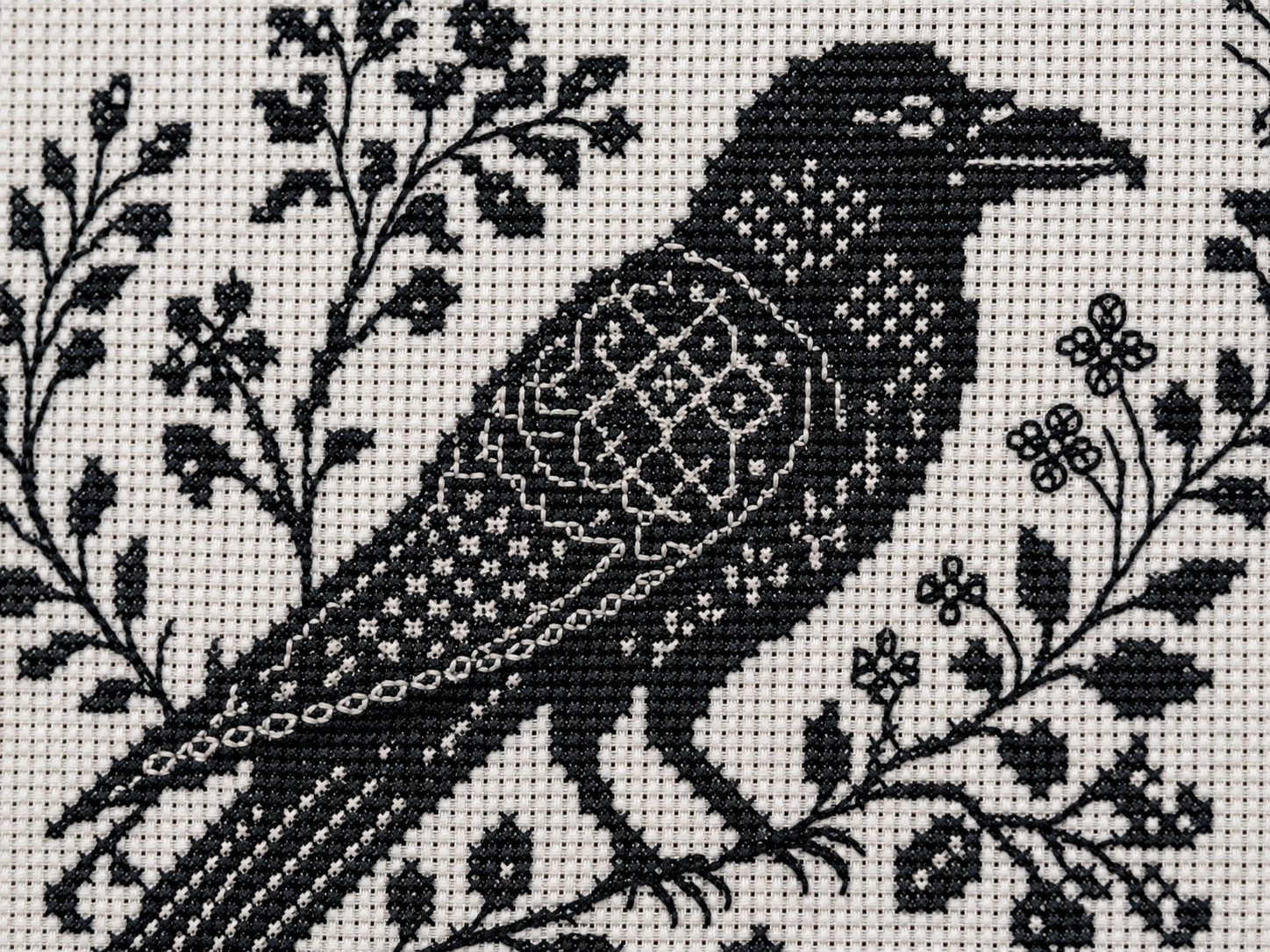
Blackwork cross stitch is a counted design style built around linework, symmetry, repeated fills and strong contrast. It borrows from traditional blackwork embroidery, but most modern stitchers use the phrase to describe cross stitch charts that include blackwork-style backstitch, geometric borders, motifs and decorative line patterns.
If you like crisp outlines, sampler bands, monochrome designs, geometric fills or patterns that feel more drawn than painted, blackwork is worth exploring. This guide covers what blackwork actually is, how the modern version differs from the historical embroidery technique, and how to design your own counted blackwork charts online.
On this page
- What is blackwork embroidery?
- Is blackwork the same as cross stitch?
- What does blackwork look like on a chart?
- Modern blackwork: how the style has evolved
- Thread, fabric and palette choices
- Simple blackwork projects for beginners
- Blackwork bookmarks, samplers and Christmas pieces
- How to design a blackwork-style pattern online
- Common blackwork mistakes (and how to avoid them)
- Tips for cleaner blackwork charts
- Where to find free blackwork patterns
- Final thoughts
What is blackwork embroidery?
Traditional blackwork is a counted-thread technique, usually worked in black thread on pale fabric. It is built up with backstitch or double running stitch, using repeated geometric fills to suggest texture and shading.
The technique has a long history. Blackwork appears in English embroidery from at least the early sixteenth century, often associated with the Tudor court. Catherine of Aragon is sometimes credited with bringing the style to England from Spain in the 1500s, though the technique was already well known in Spanish and Moorish needlework long before that. Portraits by Hans Holbein the Younger show Tudor sitters in shirts and collars edged with intricate black linework, which is where the term “Holbein stitch” comes from. Holbein stitch is the same as double running stitch and was historically the preferred method for collars and cuffs because it produces reversible work that looks neat on both sides of the fabric.
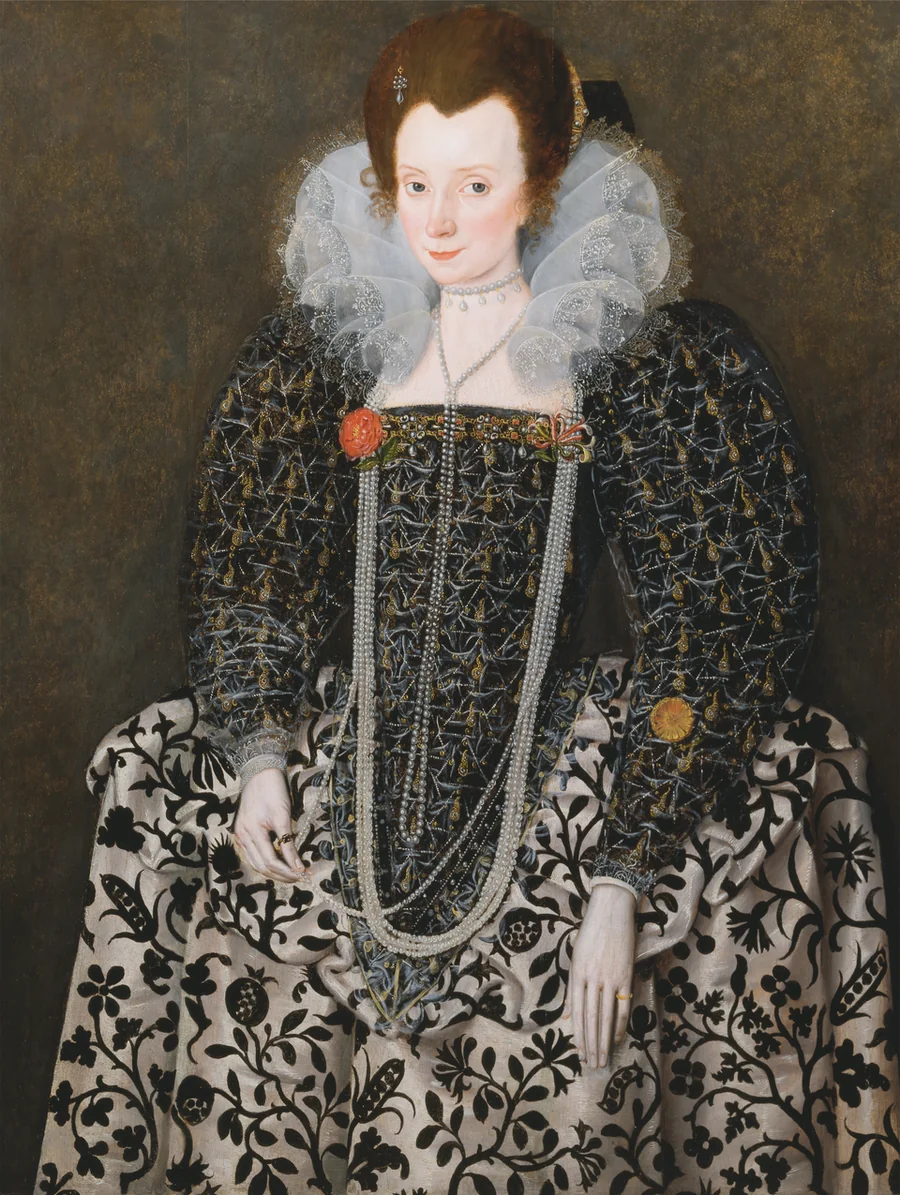 Robert Peake the Elder, “Lady in a Blackwork Petticoat”, c.1592. The dense geometric linework on the petticoat is a textbook example of Elizabethan blackwork - all counted, all repeated, all worked in black thread on pale linen. Image via Wikimedia Commons (public domain).

For more on the historical technique, including pattern books and the move from clothing decoration into framed needlework, see Wikipedia’s article on blackwork.
Blackwork has loosened considerably since then. Stitchers now use it for portraits, animals, bookmarks, samplers, lettering, mandalas and abstract geometric pieces. The important idea to hold onto is that blackwork is about lines and repeated structure rather than blocks of filled colour.
Is blackwork the same as cross stitch?
Not exactly. Cross stitch is made from X-shaped stitches on a counted grid, while blackwork is traditionally made from straight line stitches such as backstitch or double running stitch. The two techniques sit happily on the same fabric, and most modern charts mix them: full cross stitches for filled shapes, backstitch for outlines, blackwork-style fills for texture, geometric borders around a cross stitch centre, and line-based alphabets for sampler text. That blended style is usually what people mean when they search for blackwork cross stitch patterns.
If you are stitching a chart that is described as blackwork cross stitch, you will probably be working a mix of both: outlines and fills using backstitch and double running, and small cross stitch accents where the chart calls for them.
What does blackwork look like on a chart?
On a chart, blackwork shows up as lines running along the fabric grid, across diagonals or between stitch corners. You will see straight black lines, diagonal linework, repeated diamonds and squares, tiny star fills, stepped borders, sampler bands, line-based lettering and motifs arranged in rows or rings. Some charts are entirely linework. Others lay blackwork on top of full cross stitches to add texture or detail.
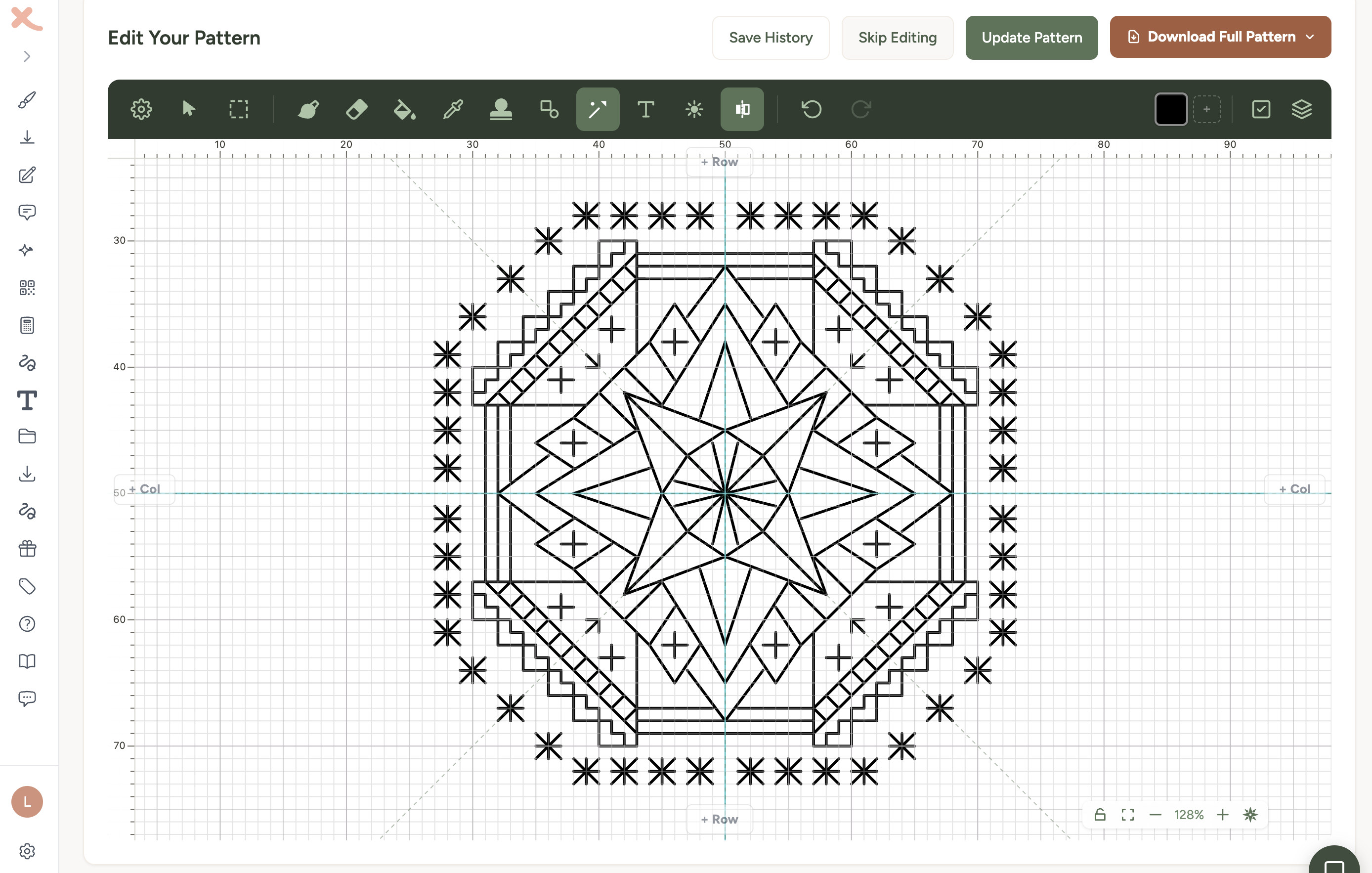
The chart above is a good example of what people usually mean by a blackwork pattern: counted, symmetrical, monochrome and built from repeated geometric motifs and stepped linework rather than blocks of filled colour. Designs like this work particularly well as standalone mandalas, hoop centrepieces or sampler features.
Modern blackwork: how the style has evolved
Historical blackwork was almost always worked in a single colour - black silk on white linen - and was used as decorative edging on clothing. The style was associated with high-status garments because the work was laborious and the dye was expensive.
Modern blackwork is much more flexible. Stitchers now use it for:
- Portraits and animals, where geometric fills replace solid shading. Each fill pattern reads as a different “shade” depending on how dense it is.
- Monochrome statement pieces in colours other than black - navy, deep red, sage, or charcoal grey are popular alternatives.
- Sampler bands, where rows of different blackwork fills are stacked vertically as a study of patterns.
- Modern abstract designs that lean into the graphic, almost screen-printed feel of dense linework.
- Hybrid charts that combine blackwork outlines with full cross stitch areas for contrast.
The line between blackwork and pulled-thread or whitework gets blurry once you move away from the historical definition. Most contemporary designers use “blackwork” loosely to mean any counted design that leans heavily on linework rather than filled blocks of colour. If a pattern calls itself blackwork in 2026, you can usually expect linework, repeats and a restricted palette - in any colour the designer chose.
Thread, fabric and palette choices
Most stitchers use stranded cotton embroidery floss such as DMC, Anchor, Madeira or Cosmo for blackwork. On 14-count Aida, two strands is the usual choice for blackwork lines because one strand often looks too thin and gets a bit lost against the fabric. One strand has its place for very fine backstitch detail, for dense fills where you want the linework to recede, or when stitching on higher counts such as 28-count evenweave or 32-count linen. If you are not sure, start with two strands and a small test patch.
Fabric choice matters too. Aida is the easiest starting point because the counted holes are obvious, but evenweave and linen give a more refined finish that suits the traditional look. A 28-count evenweave worked over two threads gives you the same stitch count as 14-count Aida but with a softer fabric feel. Use the cross stitch fabric calculator to plan finished sizes before cutting.
Traditional blackwork uses black thread on white or cream fabric, but the modern version is far more flexible. Black on white still gives you the boldest contrast, while navy on cream looks softer and more traditional. Red on white reads as folk-style, variegated thread can lift a decorative fill, and two or three related colours work nicely for modern geometric pieces. Browse the DMC colour chart if you are picking a palette and want to see how shades compare side by side.
If you are mixing cross stitch and blackwork in the same chart, test your line thickness against the filled stitches. Backstitch should read clearly without overpowering everything else.
Simple blackwork projects for beginners
Good beginner blackwork has clear repeats and not too many competing line directions. The goal early on is to build confidence with counted linework before tackling dense fills or large pieces.
Sensible starting projects:
- A bookmark with one repeated border: a long strip of fabric, a single repeating geometric edge, a name or initial worked in a line-based alphabet at the top.
- A square sampler band: stack three or four different blackwork fills in horizontal bands, each separated by a row of cross stitches.
- A small heart or star motif: about 20 by 20 stitches, with one decorative fill inside and a simple stitched outline.
- A monochrome hoop with a single border: an empty centre, a single frame of stepped linework, finished in a small hoop.
- A name worked in a backstitch font: useful as a gift, and it teaches you how blackwork-style lettering counts on the grid.
Avoid very dense fills early on. They look impressive in finished photos, but they are harder to count and easier to misread halfway through a row. Start with something where every repeat is visible at a glance.
If you want to try a blackwork alphabet, the cross stitch text generator includes several backstitch-style fonts that work well as sampler lettering, and the full cross stitch font list shows what is available.
Blackwork bookmarks, samplers and Christmas pieces
Blackwork comes into its own for certain project types. Three that suit the style particularly well:
Bookmarks. Long, narrow blackwork pieces are forgiving to design and quick to stitch. A single repeating border running the length of the bookmark, an initial at the top, and a simple stitched edge at the bottom is enough for a finished piece. Bookmark blackwork patterns are also a sensible way to practise double running stitch because the reversible side will be visible when the bookmark is in use.
Samplers. Traditional samplers stacked rows of motifs and lettering as a record of what a stitcher knew how to do. Blackwork samplers continue that tradition with bands of different geometric fills, alphabets, dates and named motifs. A modern sampler does not have to follow the historical template - you can simply pick five or six fills you like and arrange them in horizontal rows separated by thin border lines.
Christmas and seasonal pieces. Snowflakes, geometric stars, holly borders and ornaments all suit blackwork. A monochrome snowflake stitched in white on dark fabric reverses the traditional colour relationship and works beautifully as a Christmas card insert or tree ornament. Geometric Christmas borders are also a good way to use blackwork to frame a small cross stitch motif.
Other project types that suit blackwork well: monograms inside decorative frames, mandalas built on radial symmetry, biscornu (small pincushions) with mirrored geometric designs, and minimalist hoop art with a single ring of linework around blank fabric.
How to design a blackwork-style pattern online
A practical workflow looks like this. Open the pattern designer and pick a small or medium canvas, then mark the centre or the main border line so you have something to anchor everything else to. Draw one repeat unit, such as a diamond, star or stepped corner, and copy it across the row or around the frame. If the design needs words, initials or a date, add backstitch-style lettering with the text generator, and browse the cross stitch fonts if you want a line-based alphabet. Check the spacing one more time before exporting the chart.
The symmetry feature is particularly useful for blackwork. Turn on horizontal, vertical or four-way symmetry before you draw, and the same stroke is mirrored across the canvas automatically. This is much faster than drawing each side by hand and stops the design drifting out of alignment.
For a focused workflow built around line-based design, use the blackwork cross stitch designer as your starting point.
Common blackwork mistakes (and how to avoid them)
A few mistakes show up over and over in beginner blackwork. Most of them are easy to fix once you know to watch for them.
Fills that are too dense. A complex pattern fill looks great in isolation but turns into a muddy block on fabric. If a fill looks busy on the chart, it will look busier when stitched. Leave space between repeating units, or simplify the fill.
Stray single stitches. Isolated single stitches that do not form part of a fill or border are usually a sign that something has been edited without being cleaned up. Remove them - blackwork relies on the eye reading repeated structure, and stragglers break the pattern.
Lines that change direction too often. Every direction change in backstitch needs a thread anchor on the back. Designs that zigzag constantly are harder to stitch neatly and slower to work. Where possible, design so the line travels in one direction for several stitches before changing.
Lettering that is too small. Backstitch lettering needs space to read. Letters that are only 4 or 5 stitches tall often blur together once stitched, especially on lower counts like 11-count Aida.
Mixing too many fill patterns. A sampler with five different fills can work. A small heart with five different fills inside it looks chaotic. Match the number of fills to the size of the piece.
Not testing the line weight first. One strand looks different to two strands, and the difference is bigger on coarser fabrics. Stitch a small test section before committing to a full chart.
Tips for cleaner blackwork charts
Keep the design simple enough to count. Blackwork becomes frustrating when repeated fills sit too close together or look too similar to each other. Leave blank space between dense areas, let one motif establish itself clearly before introducing another, and use symmetry to keep borders balanced. Avoid stray single line segments unless they are doing real work, keep any lettering large enough to read, and check the design at the size you actually plan to stitch.
If a section looks messy on the grid, it will look messier on fabric. Simplify before you stitch.
Where to find free blackwork patterns
There are a few reliable routes to free blackwork patterns:
- Public domain Tudor and Elizabethan pattern books are available through libraries and museum digital collections. These are historically accurate and often beautiful, but the charting is sometimes hard to read by modern standards.
- Designer freebies are common on social media, Substack and Patreon. Many blackwork designers post a small free pattern alongside paid kits.
- Designing your own is often the fastest route once you know the basic shapes. A simple repeating diamond border can be drafted on a blank pattern grid in twenty minutes, and you can adjust the size to whatever you need.
If you are using a free pattern from elsewhere, check the chart symbols carefully before stitching. Blackwork notation varies by designer, particularly around the difference between backstitch and double running stitch, and between full crosses and three-quarter stitches.
Final thoughts
Blackwork cross stitch is a flexible style: part embroidery tradition, part counted design puzzle. It can be historical, modern, minimal, decorative or geometric depending on the chart in front of you.
Start small, use clear repeats, and let the grid help you. When you are ready to draw your own, the blackwork cross stitch designer gives you a blank canvas, symmetry-friendly editing, motifs, stamps and backstitch lettering tools in one place.